Most Georgia drivers who file a diminished value claim know they are owed money. The problem is knowing is not the same as proving it. Insurance companies do not hand over settlements because you feel strongly about your loss. They respond to documentation, methodology, and numbers they cannot credibly dismiss. This guide covers what actually moves the needle when you are trying to recover the market value your vehicle lost after an accident in Georgia.
Understanding What You Are Actually Proving
A diminished value claim in Georgia is a claim for a specific, measurable financial loss. Your vehicle was worth a certain amount before the accident. After the accident and repairs, it is worth less, not because anything is still broken, but because the market penalizes accident history. Buyers pay less for cars with reported damage. That gap is your diminished value.
To prove it, you need to demonstrate three things: the vehicle had a pre-loss value, the accident and repair history is now on record, and that history causes a measurable reduction in what buyers will pay today. Every piece of documentation you gather is aimed at establishing one or more of those three points.
Georgia law gives you the right to pursue this claim against the at-fault driver’s insurer. The precedent from State Farm Mutual Automobile Insurance Co. v. Mabry established that insurers cannot categorically deny third-party diminished value claims in Georgia. That ruling is your legal foundation, but the burden of proof still falls on you to put real numbers in front of the adjuster. To understand whether your situation qualifies, start with what you need to qualify for a diminished value claim in Georgia.
The Police Report: Your Starting Point
The police report establishes the official record of the accident. It documents the date, location, vehicles, drivers, and in most cases a fault assessment from the responding officer. Without it, the at-fault driver’s insurer has room to contest liability before you even get to the value argument.
In Georgia, accident reports are available through the Georgia State Patrol’s Open Records portal for crashes investigated by GSP. For accidents handled by local or county law enforcement, contact the relevant department directly. Most reports are ready within five to ten business days of the incident.
Request it early. Do not wait until you are deep in a dispute to realize you are missing the foundational document.
Complete Repair Documentation
Your repair file is the most critical piece of technical evidence you have. This includes the initial damage estimate, any supplement if additional damage was found during disassembly, the full line-by-line repair order, and the final invoice showing exactly what was done. Photos taken before, during, and after repair round out the picture.
The nature of the damage matters enormously to the size of your claim. Frame damage, airbag deployment, structural welding, and replacement of structural components all create deeper market stigma than cosmetic repairs. An adjuster reviewing your file needs to see the specific damage categories. A vague repair summary does not give them that, and an independent appraiser needs the full record to produce a defensible valuation.
A repair order that documents frame pulls, structural welds, or airbag replacement supports a significantly larger diminished value claim than one showing only panel replacement and paint. The detail in your repair records directly affects your final number.
Why the 17c Formula Is Not Proof of Anything
If you file a claim without an independent appraisal, the insurer will calculate your loss using their own internal methodology. Most often, that means the 17c formula, a framework originally developed as an internal State Farm tool that has since been widely adopted by other carriers.
The core problem with the 17c approach is structural. It starts with a 10% cap on the base value of the vehicle, applies damage and mileage multipliers that routinely bottom out, and frequently produces estimates that bear no relationship to actual buyer behavior in the market. A vehicle that would sell for $4,000 less because of its accident history on a Georgia lot might receive a 17c estimate of $800 or less.
Georgia courts have not accepted the 17c formula as the mandatory standard for valuing diminished value claims. It is the insurer’s preferred tool, not a legally binding methodology. Understanding why the 17c formula consistently undervalues real losses is essential background before you engage with any settlement offer.
The Independent Appraisal: What Actually Works
A certified diminished value appraisal from an independent appraiser is the single most effective document you can have in your file. It replaces the insurer’s calculation with an objective, market-grounded valuation that the adjuster has to address rather than simply override.
A credible appraisal uses real comparable sales data for vehicles of the same year, make, model, trim, mileage, and condition in the Georgia market. It accounts for the specific damage categories documented in the repair record. It applies consistent methodology that can be explained and defended in correspondence with the insurer or, if necessary, in Magistrate Court.
The difference in outcomes between claims filed with and without an independent appraisal is not marginal. It is the difference between accepting $500 and recovering $3,000 to $6,000 on a typical mid-range vehicle. The appraisal is not optional if you want a real settlement.
Pre-Loss Value Evidence
To prove what your vehicle lost, you first need to establish what it was worth before the accident. This is your baseline, and it needs to be grounded in real market data, not the insurer’s preferred valuation tool.
Pull comparable active listings from Georgia dealers and private sellers for the same year, make, model, trim level, mileage range, and condition. NADA and regional auction data all help establish where the market was at the time of the accident. The more specific and local your comparables, the harder they are for an adjuster to dismiss.
If your vehicle was well-maintained, documented service records from a dealer or reputable shop also support a stronger pre-loss valuation. A vehicle with a full service history commands more than one without, and that difference shows up in the comparable market data.
How Georgia Market Conditions Affect Your Proof
Georgia’s used car market does not behave the same way it did two or three years ago. Inventory has shifted, pricing has adjusted, and buyer scrutiny around accident history has increased. What this means for your claim is that the market discount for a Carfax-reported accident is now more visible and more measurable in Georgia than it was during the tight inventory period when buyers had less leverage.
The impact of 2026 used car price drops on Georgia diminished value claims matters here. When clean-title vehicles are selling at lower prices, accident-history vehicles are discounted even further. Your claim needs to reflect the actual Georgia market at the time of your loss, not a national average that may not capture local conditions.
Presenting Your Claim: What Moves Adjusters
Adjuster behavior is driven by what they can document internally to justify a payment. When your file is thin, they have cover to deny or minimize. When your file includes a police report confirming fault, a detailed repair order, a Carfax showing the accident flag, and a certified independent appraisal with real comparables, their ability to dismiss your claim shrinks dramatically.
The formal demand letter is the mechanism that puts it all on record. A written demand citing the specific dollar figure from your appraisal, attaching your supporting documents, and referencing the Georgia legal precedent supporting your right to file is the proper way to open the negotiation. Many experienced appraisers include a demand letter as part of their service.
Keep written records of every exchange with the insurer. If they deny your claim, that denial on record is the foundation for the next step. Our guide on what to do when your diminished value claim is denied in Georgia walks through each path in detail.
What Does Not Work
A few common mistakes that consistently produce poor outcomes:
- Filing without documentation. A claim based on a verbal description of your loss gives the adjuster nothing to approve and everything to deny.
- Accepting the first offer without a counter. The first offer from the insurer is almost never the final number they are willing to pay. It is an opening position. Our breakdown of whether to accept the first diminished value offer in Georgia explains the leverage you have before signing.
- Using online calculators as primary evidence. Calculator tools produce estimates, not appraisals. An adjuster will not treat a calculator output the same way they are required to address a certified appraisal.
- Waiting too long. Georgia’s statute of limitations for property damage claims under O.C.G.A. Section 9-3-31 is four years from the accident date. Repair records and comparable market data become harder to reconstruct over time. Filing while the evidence is fresh produces stronger claims.
Your Proof Checklist
| Document | Why It Matters | Without It |
|---|---|---|
| Police Report | Establishes fault on record | Liability easily disputed |
| Full Repair Order + Invoice | Documents damage categories | Damage appears minor by default |
| Independent DV Appraisal | Quantifies real market loss | Insurer controls the number |
| Vehicle History Report | Confirms accident is on record | Claim may appear speculative |
| Pre-Loss Comparables | Establishes value baseline | Insurer sets the baseline instead |
| Formal Demand Letter | Creates paper trail, forces response | Claim stays informal, easy to ignore |
Ready to Build a Claim the Insurer Has to Take Seriously?
Get a free estimate from Georgia’s most experienced diminished value appraisers. Send us your repair documents and we will tell you exactly what your vehicle’s loss is worth.Get Your Free DV Estimate
Want to keep this guide for reference? Download the PDF Version
Frequently Asked Questions
Do I need a professional appraisal to prove diminished value in Georgia?
You are not legally required to have one, but filing without it puts you at a significant structural disadvantage. Without an independent appraisal, the insurer will apply their own valuation formula, and you will have no credible basis to challenge the number they produce. A certified appraisal is the only document that gives you a defensible figure to negotiate from.
Can I prove diminished value if my repair records are incomplete?
Incomplete records weaken your claim but do not automatically eliminate it. Start by contacting your repair shop and requesting any documentation they retain. Your insurance company may also have adjuster photos and estimates from the initial inspection on file. A certified appraiser can often work with partial documentation and identify what additional evidence would strengthen the file.
What if the insurer says the repairs restored full value?
This is the most common denial argument and it has been rejected by Georgia courts. Repairs can bring a vehicle back to operational condition, but they cannot remove the accident record from vehicle history reports. Buyers in Georgia’s used car market consistently pay less for vehicles with documented accident history, regardless of repair quality. An independent appraisal using real market comparables demonstrates this gap with specific numbers.
How long do I have to file a diminished value claim in Georgia?
Georgia’s statute of limitations for property damage claims under O.C.G.A. Section 9-3-31 is four years from the date of the accident. That window is longer than most states, but it is not unlimited. Evidence degrades over time. Filing while your documentation is complete and the market data is current produces a stronger outcome.
What happens if the insurer denies my claim even with a full appraisal?
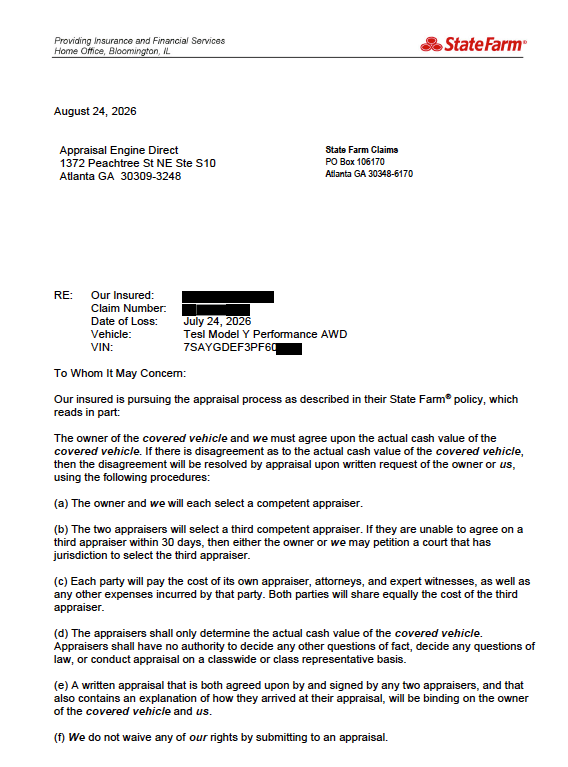
A denial is not the end of the process. Depending on the policy language, you may have the right to invoke the appraisal clause, which requires the insurer to appoint their own independent appraiser and for both appraisers to agree on an umpire if they cannot reach agreement. If the policy route is exhausted, Georgia Magistrate Court handles property damage claims up to $15,000 and is a realistic option for documented claims where the insurer refuses to negotiate in good faith.