Our Patent-Pending Method for Calculating Diminished Value
Most auto appraisers rely on the same outdated formulas that insurance companies use — including the widely criticized 17C formula — to calculate how much value your vehicle lost after an accident. We don’t.
Diminished Value of Georgia developed and filed a proprietary methodology for calculating diminished value in repaired vehicles, published by the United States Patent and Trademark Office under Patent Publication No. 2020/0143433 A1. This is the same methodology used in every appraisal report we produce — and it is the reason our clients consistently achieve settlements that far exceed the insurance company’s initial offer.
Official Patent Documents
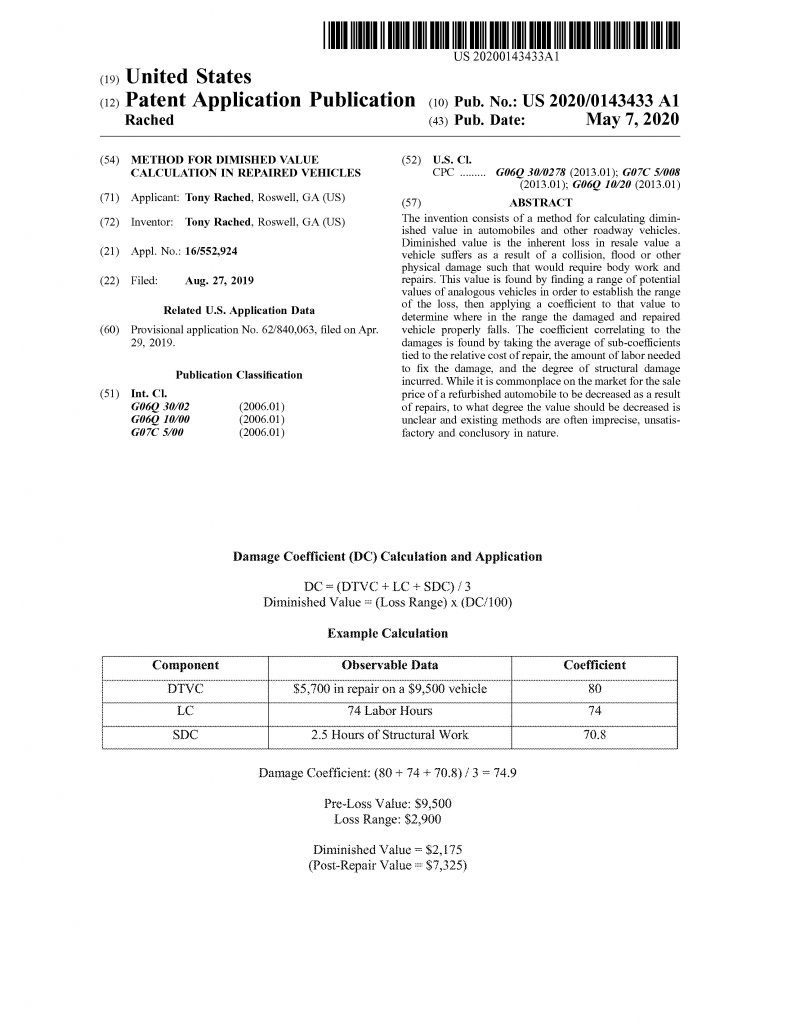
USPTO Patent Publication No. 2020/0143433 A1 — filed by Diminished Value of Georgia

Download the full patent filing (PDF) →
Why a Better Calculation Method Matters
The difference between a standard diminished value formula and a market-based methodology isn’t minor — it can mean thousands of dollars in your settlement.
The 17C formula, which most insurance companies default to, caps your payout at 10% of the vehicle’s pre-accident value and then applies a series of multipliers that further reduce the figure. It was designed for the mass processing of class-action claims in 2002 — not for calculating the true market impact of accident history on an individual vehicle in today’s market.
Our patent-pending approach does something fundamentally different. Instead of applying arbitrary caps and damage modifiers, it uses actual comparable vehicle sales data to measure the real-world price difference between accident-history vehicles and clean-title vehicles of the same make, model, year, trim, and condition in your geographic area. The result is a defensible, market-supported number — not a formula engineered to minimize your payout.
| Feature | 17C Formula (Insurer) | DVGA Patent-Pending Method |
|---|---|---|
| Based on real market sales data | ✗ No | ✓ Yes |
| Geographic market adjustment | ✗ No | ✓ Yes |
| Vehicle-specific damage analysis | ✗ Generic multipliers only | ✓ Yes |
| USPAP compliant | ✗ No | ✓ Yes |
| Accepted in Georgia courts | ✗ Not determinative | ✓ Yes |
| Payout cap | ✗ 10% of ACV maximum | ✓ No artificial cap |
| Designed to protect the insured | ✗ No — designed to limit liability | ✓ Yes |
What Makes This Methodology Different
Traditional diminished value formulas share three critical flaws that systematically undervalue your claim:
The Three Flaws in the 17C Formula
- Book values instead of transaction data. The 17C formula starts with NADA guide values, which reflect regional averages — not what real buyers in your specific market are actually paying.
- Blanket damage multipliers. A generic structural damage modifier is applied regardless of the specific damage type, repair quality, or vehicle desirability — producing results that bear no relationship to real market impact.
- Double-counted mileage adjustment. Mileage is already factored into the vehicle’s base retail value. Applying it again as a separate multiplier artificially reduces the payout — and eliminates recovery entirely for vehicles with over 100,000 miles.
Our methodology addresses each of these weaknesses by anchoring the diminished value calculation to actual market evidence. We analyze real completed sales of comparable vehicles with and without accident histories in your geographic area, isolating the price impact of the accident record itself.
This produces a figure that reflects what a real buyer in your real market would actually pay less for your specific vehicle — which is the only number that matters when you go to sell or trade it in.
USPAP Compliance and Legal Defensibility
Every appraisal report produced by Diminished Value of Georgia is USPAP-compliant — meaning it meets the Uniform Standards of Professional Appraisal Practice set by The Appraisal Foundation, the same standards required in federal and state court proceedings.
Our patent-pending methodology is built on top of this compliance framework, which means our reports aren’t just accurate — they’re built to hold up under scrutiny from insurance adjusters, opposing counsel, and judges alike.
Our Reports Are:
- USPAP-compliant and professionally certified
- Recognized by all major insurance carriers operating in Georgia
- Accepted as evidence in Georgia magistrate and superior courts
- Accompanied by a demand letter tailored to your specific claim
- Produced by licensed appraisers — not software, not templates
- Based on proprietary market analysis, not insurer-designed formulas
About the Patent Filing
In 2020, Diminished Value of Georgia filed a patent application with the United States Patent and Trademark Office for our proprietary method of calculating diminished value in repaired vehicles. The application was published under Patent Publication No. 2020/0143433 A1 and is indexed on Google Patents under the title “Method for Diminished Value Calculation in Repaired Vehicles.”
The patent covers the systematic process by which vehicle sales data, accident history records, market comparables, and geographic variables are combined to produce a defensible calculation of post-repair diminished value. This process goes well beyond what any insurance company’s internal formula accounts for — and it is the foundation of every appraisal report we issue.
A second related filing — USPTO Publication No. 20210056597, titled “Method of Diminished Value Calculation in Repaired Vehicles” — extends the original methodology. Both documents are publicly available and linked above for review.
Every Client Gets the Benefit of This Methodology
You don’t need to understand the technical details of the patent to benefit from it. When you order an appraisal from Diminished Value of Georgia, our licensed appraisers apply this proprietary framework to your specific vehicle, your specific accident, and your specific market — and deliver a report that gives you real leverage in your claim negotiation.
The insurance company has their formula. Now you have ours.
Get an Appraisal Based on Our Proprietary Methodology
Flat-fee appraisals from $275. No contingency fees. No percentage of your settlement. What you collect is yours.
Free Claim Review Call (678) 404-0455