You filed your diminished value claim in Georgia, did everything right, and the insurer came back with a flat denial or a number so low it might as well be one. This happens more often than most drivers realize, and it does not mean you are out of options. A denial is not a final answer. It is the beginning of a different conversation, one where documentation, legal standing, and persistence determine who wins.
Georgia law is actually on your side here. The landmark ruling in State Farm Mutual Automobile Insurance Co. v. Mabry established that insurers cannot categorically deny diminished value claims in Georgia. But knowing you have a right and knowing what to do after a denial are two different things. This article walks you through exactly what happens next and what you can do about it.
Why Insurers Deny Diminished Value Claims
Before responding to a denial, it helps to understand what is actually behind it. Insurers deny or heavily discount DV claims for a handful of predictable reasons:
- They claim the repairs restored full value. This is the most common denial language. The adjuster argues the vehicle was repaired to pre-loss condition, therefore no residual loss in value exists. It sounds logical. It is not accurate. Buyers and the market disagree.
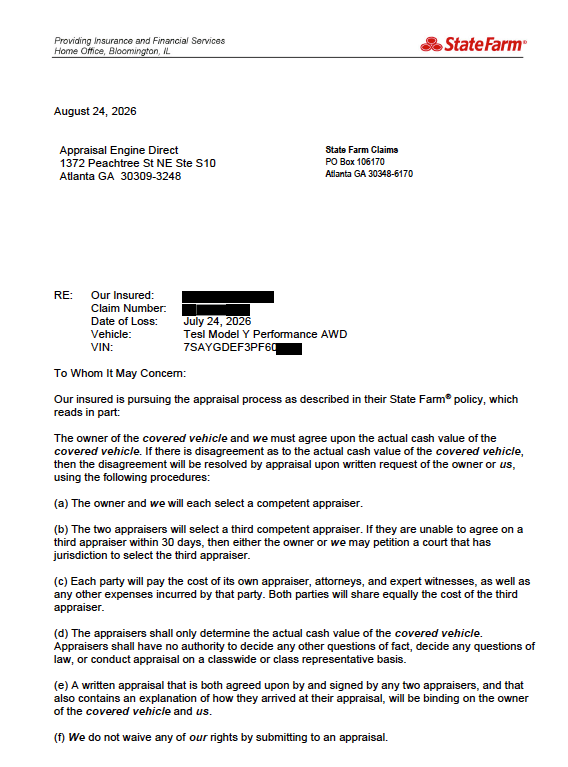
- They use the 17c formula and call it final. The 17c formula is an internal insurer tool that caps potential DV recoveries at 10% of the vehicle’s value, then applies reductions that often bring the final number to near zero. It is not required by Georgia law and courts have rejected it as the only acceptable methodology.
- They argue the vehicle was too old or had too many miles. Older or higher-mileage vehicles do experience less diminished value, but that is not the same as experiencing none. Many vehicles well past their first few years still carry meaningful market value that takes a real hit after an accident.
- They deny on policy language grounds. Some denials claim the policy does not cover diminished value. In a third-party claim, this argument does not hold. You are not bound by the at-fault driver’s policy limitations when making a property damage claim against their liability coverage.
A denial letter is a position, not a verdict. The insurer’s job is to minimize payouts. Your job is to know when their reasoning does not hold up and respond accordingly.
Step One: Read the Denial Letter Carefully
The denial letter matters. Read every word of it, because the specific language the insurer uses tells you exactly which argument they are making and which counterargument you need to prepare.
If the denial claims full value was restored by repairs, the response is a professional independent appraisal showing the actual market impact. If the denial cites policy language, the response is a clarification that you are filing a third-party liability claim, not a first-party claim under the at-fault driver’s policy. If the denial uses the 17c formula, the response is a competing appraisal based on real comparable sales data along with a documented challenge to the formula’s methodology.
Do not respond emotionally. Respond with evidence. Keep every piece of written communication because it becomes part of your file if the dispute escalates.
Step Two: Get an Independent Professional Appraisal
If you filed your original claim without a professional appraisal, getting one now is the single most important step you can take. An independent appraisal gives you a certified, documented dollar figure based on real market data and comparable sales. It takes the insurer’s number off the table as the only reference point.
The 17c formula that insurers rely on has been challenged in Georgia courts specifically because it produces results that do not reflect actual market behavior. An appraiser who documents real comparable sales, current market conditions in Georgia, and the specific damage profile of your vehicle gives you ammunition that the formula simply cannot counter.
This appraisal also matters for what comes next. Whether you escalate through a demand letter, mediation, or small claims court, the appraisal is the core evidence underlying your number. Without it, you are making an argument without proof.
Step Three: Send a Formal Demand Letter
A demand letter is a formal written notice to the insurer stating your documented loss and the specific amount you are demanding as compensation. It puts the dispute on record, establishes a paper trail, and signals that you are prepared to escalate.
The letter should reference the independent appraisal directly, cite the State Farm v. Mabry ruling and Georgia’s legal framework for diminished value recovery, and set a clear deadline for response, typically 10 to 15 business days.
Many claims that were initially denied get resolved at this stage. Insurers know that a claimant with a professional appraisal and a formal demand letter is far more likely to follow through than one who accepted the denial. The economics of fighting a well-documented claim often make a negotiated settlement more attractive than continued resistance.
A demand letter is not a legal filing. You do not need an attorney to send one. But it carries significant weight when it includes a certified appraisal, specific dollar figures, and a clear legal basis for the claim.
Step Four: File a Complaint With the Georgia Department of Insurance
If the insurer ignores the demand letter or continues to deny without valid justification, you can file a formal complaint with the Georgia Department of Insurance. This is not a lawsuit. It is an administrative complaint that triggers a review of the insurer’s handling of your claim.
Georgia’s unfair claims settlement practices laws require insurers to investigate claims promptly, communicate decisions clearly, and provide valid reasons for any denial. A pattern of low offers, unexplained denials, or refusal to engage with your documentation may constitute a violation. The DOI complaint process creates a formal record and sometimes applies enough pressure to move a stalled claim.
Filing through the DOI is free. The process requires you to document the claim history, the denial, and your attempts to resolve the dispute. Our overview of Georgia diminished value laws and your rights covers the regulatory framework in detail.
Step Five: Consider Small Claims Court
For claims that fall within the limit, Georgia’s Magistrate Court, commonly called small claims court, is a legitimate and accessible option. In Georgia, the limit for Magistrate Court is $15,000, which covers the majority of individual diminished value claims.
You do not need an attorney to file in Magistrate Court. You file against the at-fault driver directly, not the insurance company, and the insurer typically assigns a representative or defense attorney. Your independent appraisal is your primary evidence.
Courts in Georgia have consistently recognized diminished value as a recoverable damage. The State Farm v. Mabry precedent is well-established. A well-documented claim with a credible independent appraisal has a strong foundation in this venue.
| Escalation Step | When to Use It | What It Requires |
|---|---|---|
| Demand Letter | After initial denial or low offer | Appraisal + written summary of claim |
| DOI Complaint | After demand letter is ignored or rejected | Documented claim history + denial letter |
| Magistrate Court | Claims under $15,000, insurer refuses to pay | Appraisal + accident + repair records |
| Attorney-Assisted Filing | High-value claims or complex liability disputes | Attorney consultation, full documentation |
What Strengthens Your Position at Every Stage
Regardless of which escalation path you take, several factors consistently make the difference between a claim that gets paid and one that does not:
- An independent appraisal from a certified professional. Not an online estimate. Not the insurer’s formula. A real appraisal based on market comparables and your vehicle’s specific damage history.
- A complete repair record. Every line item on the repair order matters. Frame work, structural repairs, airbag replacements, and welding are all factors that drive diminished value higher. Incomplete documentation understates your loss.
- A written paper trail with the insurer. Every communication in writing. Every deadline you set. Every position they take. This record matters in court and before the DOI.
- Knowledge of the statute of limitations. Under O.C.G.A. Section 9-3-31, you have four years from the date of the accident to file a property damage claim in Georgia. Do not let time pressure you into accepting a bad offer, but also do not wait until the window is closing.
Georgia’s current used car market conditions are also relevant context. As vehicle values shift, the gap between a clean-title vehicle and one with an accident history on its Carfax is real and measurable. That gap is your diminished value, and it belongs to you.
Your Claim Was Denied. Here Is What to Do Next.
Get a certified independent appraisal and a free DV estimate from Georgia’s most experienced diminished value appraisers. We will tell you exactly what your vehicle lost in value and give you a number you can actually use.Get Your Free DV Estimate
Download This Article as a PDF
Save or share a formatted version of this guide.
Frequently Asked Questions
Can a Georgia insurer legally deny a diminished value claim outright?
Not without valid justification. The State Farm Mutual Automobile Insurance Co. v. Mabry ruling established that insurers cannot categorically deny diminished value claims in Georgia. A blanket denial that does not address your specific vehicle or loss is legally vulnerable. If you received one, document it and respond with an independent appraisal and a formal demand letter.
What is the 17c formula and why do insurers use it?
The 17c formula is an internal valuation methodology developed by State Farm that caps potential DV at 10% of vehicle value, then applies a series of multipliers that frequently reduce the final payout to a fraction of the actual market loss. Insurers use it because it produces predictably low numbers. It is not required by Georgia law and has been challenged in court. An independent appraisal based on real comparable sales is a valid and more accurate alternative.
How long do I have to respond to a denial before my rights expire?
Under O.C.G.A. Section 9-3-31, Georgia’s statute of limitations for property damage claims is four years from the date of the accident. However, acting sooner is always stronger. Evidence is easier to gather, comparable sales data is more relevant, and you avoid any risk of the window closing while the dispute is still unresolved.
Do I need an attorney to fight a denied diminished value claim in Georgia?
Not necessarily. Many denied claims are resolved through a demand letter backed by an independent appraisal, without legal counsel. For claims under $15,000, Magistrate Court is accessible without an attorney. For larger claims or complex liability disputes, consulting with an attorney who handles property damage cases may be worthwhile.
What if the insurer made a low offer instead of a flat denial?
A low offer and a denial call for the same response: get an independent appraisal that documents your actual loss, then submit a formal demand letter with the appraisal attached. The gap between their offer and your documented number is the basis for negotiation. Many low offers are revised significantly once the insurer receives a credible independent appraisal.
Can I file a diminished value claim if the accident happened several months ago?
Yes. As long as you are within the four-year statute of limitations, you can still file. The claim process does not require you to act within days of the accident. That said, gathering repair documentation, photos, and comparable market data becomes progressively harder as time passes. If your repairs are complete, the sooner you move, the stronger your file.