You did everything right. You bought a 2025 model, low miles, clean history, paid a fair price for a car that felt like new without the new-car premium. Then someone ran a red light on I-285, or rear-ended you on Peachtree, or clipped you pulling out of a parking deck in Midtown. Now your car is repaired, it looks fine, and the insurer is telling you everything is taken care of. It is not. A nearly-new car accident in Georgia does not just leave physical damage. It leaves a financial hole that most drivers never fully see until they try to sell.
The Market Just Made Your Nearly-New Car Worth Less. The Accident Made It Worse.
Here is something that happened quietly while you were busy with life: 2025 model year used vehicles have lost significant value in 2026. Recent transaction data shows the average 2025 used vehicle selling for around $37,500 while comparable new 2026 models are transacting near $48,800. That gap of over $11,000 is the largest recorded in at least a decade, driven by automaker incentives on new inventory and a wave of nearly-new trade-ins flooding the market.
If you bought a 2025 vehicle for $45,000, it may now be worth $36,000 to $38,000 in the current Georgia market before a single word about accident history enters the picture. That is market depreciation, and it happened to every 2025 vehicle in Georgia, yours included.
Then add the accident.
Market depreciation is what the 2026 used car market did to your car. Diminished value is what the accident did on top of that. Both losses are real. Only the second one is yours to recover.
What Diminished Value Actually Means for a Nearly-New Georgia Vehicle
Diminished value is the permanent reduction in your vehicle’s resale price caused by its accident history. After repairs are complete, a buyer running a Carfax or AutoCheck on your 2025 vehicle will see the accident flag. That flag costs you money every time you try to sell, trade in, or negotiate. It does not go away when the body shop closes the repair order.
Georgia law is clear on this. The at-fault driver’s insurer is responsible for your full property damage, which includes diminished value. The landmark case State Farm Mutual Automobile Insurance Co. v. Mabry established this right for Georgia drivers. The insurance company cannot legally tell you that diminished value is not a covered loss under third-party liability. What they can do, and routinely do, is offer you far less than the actual loss.
For nearly-new vehicles, the gap between what insurers offer and what the market actually penalizes is larger than for older vehicles. A 2025 car or truck with 15,000 miles had more value to protect. The accident history matters more to buyers, and the dollar impact is proportionally higher.
The Double Hit: How the Numbers Stack Up in Georgia
Consider a Georgia driver who bought a 2025 midsize SUV for $47,000 in late 2024. By mid-2026 the vehicle has been in a collision and repaired. Here is what the financial picture actually looks like:
| Loss Type | Amount | Who Absorbs It |
|---|---|---|
| Market depreciation (2025 MY drop) | -$9,000 to -$11,000 | You, unavoidable |
| Diminished value from accident history | -$4,000 to -$7,000 | At-fault insurer (recoverable) |
| Total loss vs. purchase price | -$13,000 to -$18,000 | Combination of both |
| What insurer typically offers (17c formula) | -$1,500 to -$2,500 | Far below actual loss |
The 17c formula is what most Georgia insurers use to calculate diminished value. It is an internal tool originally developed by State Farm, not a legal standard or independent methodology. It caps the calculation at 10% of the vehicle’s value before applying multipliers that routinely produce payouts of $1,500 to $3,000 on vehicles where the real market loss is three to five times higher. Our breakdown of why the 17c formula is not fair explains exactly how it works against you.
Why Georgia Buyers Discount Nearly-New Accident-History Vehicles Hard
The Georgia used car market is active and competitive. The Atlanta metro area is one of the largest used vehicle markets in the Southeast, and buyers here have options. When a shopper searches for a 2025 RAV4, Camry, F-150, or Silverado and sees two similar listings, one with clean history and one with an accident flag, the clean one commands a premium. Every time.
The discount is not just buyer preference. It reflects real concerns: structural integrity, undisclosed sensor damage, ADAS calibration quality, and future insurance complications. Buyers know that a vehicle with accident history is harder to insure at full value and harder to sell again later. They price that risk in aggressively, especially on nearly-new vehicles where they expect to hold the car for years.
This is exactly why qualifying for a diminished value claim in Georgia matters so much on 2024 and 2025 model year vehicles. The loss is larger and more measurable.
What to Do Right Now If Your Nearly-New Georgia Vehicle Was in an Accident
The window to build the strongest possible claim is right after repairs are complete. Here is what needs to happen:
- Do not accept the insurer’s diminished value offer without an independent appraisal. Their first number is based on a formula designed to minimize payouts. It is not a certified valuation of your actual market loss.
- Get a professional DV appraisal that reflects current Georgia market conditions. Online calculators and insurer estimates do not account for what 2025 model year vehicles are actually selling for in Atlanta, Marietta, Alpharetta, or Savannah right now. A local market appraisal does.
- Document everything from the repair. Frame work, structural repairs, ADAS calibration records, and airbag replacement all affect your diminished value calculation. A thorough repair record supports a larger, more defensible claim.
- File the claim before the market moves again. Comparable sales data from today establishes your baseline. The longer you wait, the harder it becomes to lock in an accurate pre-loss value and document the current market penalty for accident history.
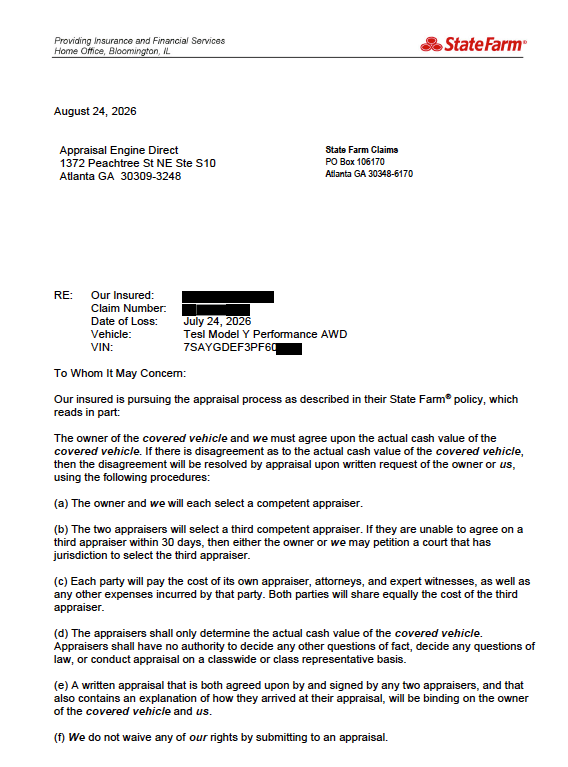
- Know your rights under Georgia law. The at-fault insurer cannot legally refuse to discuss diminished value. If they deny or lowball the claim, you have options including a formal demand letter, the appraisal clause in the policy, and Magistrate Court. Our guide on Georgia diminished value laws covers your full set of rights.
The Free Estimate Is the Right First Step
Before you decide whether to file, before you respond to the insurer’s offer, and before you sign anything, get a free estimate from an independent appraiser who knows the Georgia market. It costs you nothing and gives you the one thing you need going into any negotiation: an accurate number.
Georgia drivers with nearly-new vehicles have more at stake in 2026 than in most years, because market depreciation has already compressed values before the accident history is even factored in. The 2026 used car price drops affecting Georgia have changed the baseline for every claim filed this year. Your appraisal needs to reflect that reality.
Get Your Free Georgia Diminished Value Estimate
Your nearly-new car lost value twice: once from the market, once from the accident. Only one of those losses belongs to you. Find out exactly what the other one is worth.
Download This Article as a PDFSave or share a formatted version of this guide.
Frequently Asked Questions
Does it matter that my 2025 vehicle already lost market value before the accident?
Market depreciation and diminished value are two separate losses. The market drop affects every 2025 model year vehicle in Georgia. Diminished value is the additional penalty your specific vehicle carries because of its accident history. You cannot recover market depreciation from the insurer, but you can recover the diminished value portion, which for nearly-new vehicles is often $4,000 to $8,000 or more depending on the severity of the damage and the vehicle’s make and model.
Can I file a diminished value claim in Georgia even if my car looks fully repaired?
Yes. The claim is not about visible damage. It is about what accident history does to your vehicle’s resale value in the marketplace. A fully repaired 2025 vehicle with an accident flag on its Carfax will sell for less than an identical vehicle with a clean history. That gap is measurable and recoverable under Georgia law.
How do I know if the insurer’s diminished value offer is fair?
If the insurer used the 17c formula, the offer is almost certainly below actual market loss. The 17c formula caps the calculation at 10% of the vehicle’s value and applies multipliers that reduce the number further. For a nearly-new vehicle worth $40,000, the formula typically produces offers of $1,500 to $3,000 when the real market penalty may be $5,000 to $8,000. An independent appraisal gives you a defensible comparison.
How long do I have to file a diminished value claim in Georgia?
Georgia’s statute of limitations for property damage claims is four years from the date of the accident under O.C.G.A. Section 9-3-31. That is longer than most people assume, but waiting weakens your case. Repair documentation, market comparables, and evidence of the accident’s impact on value are all easier to establish soon after the repairs are completed.
Does the severity of the damage affect how much diminished value I can recover?
Yes. More extensive damage, particularly structural repairs, frame work, airbag deployment, and ADAS component replacement, generally produces higher diminished value because buyers and the market treat those repairs as more significant stigma. A nearly-new vehicle with documented structural repair history will carry a larger market value penalty than one with only cosmetic repairs.