If your car was damaged in an accident that was not your fault, the clock started ticking the moment the other driver hit you. Most Georgia drivers assume they have plenty of time to deal with a diminished value claim later, after the repairs are done and life settles back down. That assumption costs people real money. Knowing how long you have to file a diminished value claim in Georgia is only half the story. The legal deadline is generous, but the practical window where your claim is actually strong closes a lot faster than the statute suggests.
This guide breaks down the actual filing deadlines under Georgia law, why the deadline against your own insurer is different from the one against the at-fault driver, and why waiting almost always works against you even when you are still technically within the legal limit.
The Legal Deadline: Four Years in Georgia
Georgia treats diminished value as a form of property damage, and property damage claims fall under a specific statute of limitations. Under O.C.G.A. Section 9-3-31, you generally have four years from the date of the accident to file a claim for damage to your vehicle. That four-year window applies to the loss in market value your car suffers because it now carries an accident on its history report.
Four years is longer than most drivers expect, and it is longer than the deadline for personal injury claims in Georgia, which sit at two years under O.C.G.A. Section 9-3-33. The gap between those two numbers trips people up constantly. A driver who settles the injury side of a claim quickly often assumes the property side closed at the same time. It did not. The diminished value portion can remain open well after the injury claim is resolved.
The four-year deadline runs from the date of the accident, not the date repairs were completed or the date you noticed the value loss. If you are unsure when your clock started, assume it began the day of the collision.
First-Party vs. Third-Party: Two Different Clocks
Here is the part that almost no one explains clearly. The deadline to file a diminished value claim depends on who you are filing against, and the two paths run on different clocks.
Third-Party Claims (Against the At-Fault Driver)
When another driver causes the accident, you file against their liability coverage. This is a third-party claim, and it is governed by the statute of limitations: four years from the accident date under O.C.G.A. Section 9-3-31. This is the path most Georgia diminished value claims take, because diminished value is most commonly pursued when you were not at fault.
First-Party Claims (Against Your Own Insurer)
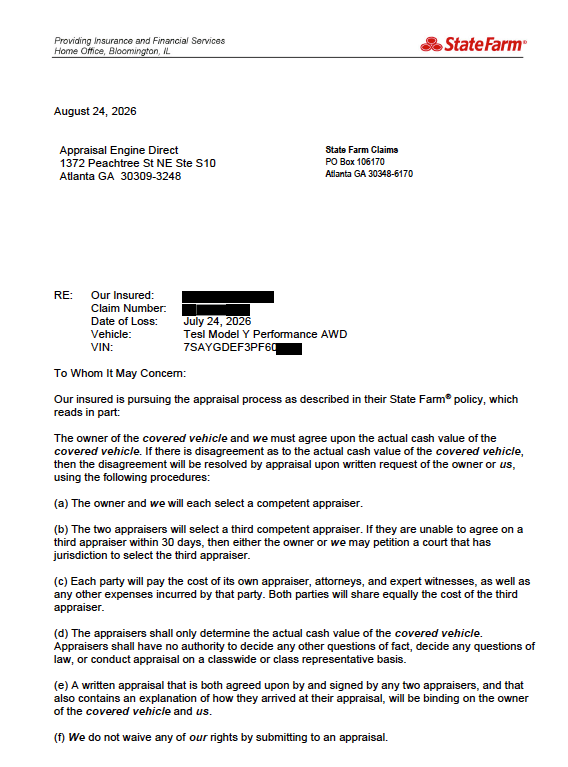
When you pursue diminished value through your own policy, you are filing a first-party claim, and this is governed by your insurance contract, not just the statute. The landmark case State Farm Mutual Automobile Insurance Co. v. Mabry established that Georgia insurers must assess and pay first-party diminished value. But your policy may contain its own notice requirements and time limits for filing, and those contractual deadlines can be shorter than the four-year statutory window. Some policies require prompt notice of a loss, and failing to meet that requirement can give your insurer grounds to deny.
If you are filing against your own insurer, read your policy’s notice and proof-of-loss provisions before you assume you have four years. The statute sets the outer limit, but your contract may set a tighter one.
If you are not certain whether your situation even qualifies for a claim in the first place, our breakdown of whether you qualify for diminished value is the right place to start before worrying about deadlines.
Deadlines at a Glance
| Claim Type | Filed Against | Time Limit |
|---|---|---|
| Third-party diminished value | At-fault driver’s insurer | 4 years from accident date |
| First-party diminished value | Your own insurer | Set by policy contract, often shorter |
| Property damage (general) | At-fault party | 4 years (O.C.G.A. 9-3-31) |
| Personal injury (for comparison) | At-fault party | 2 years (O.C.G.A. 9-3-33) |
Why the Legal Deadline Is the Wrong Thing to Focus On
Four years sounds comfortable. The problem is that your claim does not stay equally strong across those four years. It weakens steadily, and the damage starts almost immediately. The legal deadline tells you when you lose the right to file at all. It tells you nothing about when you lose the ability to win.
Here is what erodes while you wait:
- Repair records disappear. Body shops are not required to keep your file forever. The detailed repair order that proves frame work, structural repair, or component replacement is the backbone of your claim. Lose it and you lose your leverage.
- Market comparables get harder to pin down. Diminished value is measured against what your specific vehicle would have sold for in the Georgia market at the time of the loss. Reconstructing that pricing two or three years later is far less precise than doing it while the data is fresh.
- The insurer questions the delay. Adjusters use time against you. A claim filed years after the accident invites the argument that any value loss came from something else: later wear, mileage, a second incident, or general depreciation rather than the accident itself.
- Memory and documentation fade. Witness recollections, photos, and the paper trail all degrade. The cleaner and more recent your file, the harder it is for an adjuster to poke holes in it.
The strongest diminished value claim is one filed shortly after repairs are completed, while the documentation is complete and the loss is easy to tie directly to the accident. Our guide on Georgia’s diminished value laws covers the legal framework in more depth if you want the full picture.
The Best Window to File
If there is a single takeaway here, it is this: do not measure your timeline against the four-year deadline. Measure it against the repair completion date. The ideal sequence looks like this.
- Get the accident documented and obtain the police report.
- Complete repairs and collect the full repair order and final invoice.
- Order an independent diminished value appraisal while the records are fresh.
- Submit the claim with the appraisal and a demand letter to the responsible insurer.
Filing within weeks of repair, not years, is what separates a claim that gets paid from one that gets argued into the ground. The professional appraisal is the piece that turns your claim from an opinion into a documented figure the insurer has to respond to. Without it, the insurer falls back on the discredited 17c formula, which routinely produces numbers far below the real market loss.
Do Not Let the Clock Run Out on Your Claim
The sooner you act, the stronger your case. Get a free estimate from Georgia’s trusted diminished value appraisers and find out exactly what your claim is worth.Get Your Free DV Estimate
Prefer to read this offline?
Download a clean PDF version of this guide to keep on file or share with anyone handling your claim. Download the PDF Guide
Frequently Asked Questions
How long do I have to file a diminished value claim in Georgia?
For a third-party claim against the at-fault driver’s insurer, you generally have four years from the date of the accident under O.C.G.A. Section 9-3-31. If you are filing through your own insurer, your policy may impose a shorter notice deadline, so check your contract. Either way, filing soon after repairs are complete produces a far stronger claim than waiting.
Does the four-year deadline start on the accident date or the repair date?
The statute of limitations runs from the date of the accident, not the date repairs were finished or the date you discovered the value loss. If you are uncertain, treat the collision date as the start of your clock to stay safe.
Can I still file if my accident happened over a year ago?
Yes, as long as you are within the four-year statutory window for a third-party claim. That said, your claim is weaker the longer you wait. Repair records may be gone and the insurer is more likely to dispute the cause of the value loss. Gather your documentation and get an appraisal as soon as possible.
Is the deadline different if I file against my own insurance?
Yes. A first-party claim is governed by your insurance contract in addition to the statute. Many policies require prompt notice of a loss, and missing that contractual window can give your insurer grounds to deny even though the four-year statutory limit has not passed. Read your policy’s notice provisions carefully.
What happens if I miss the filing deadline entirely?
Once the statute of limitations expires, you lose the legal right to pursue the claim. The insurer can deny it outright on that basis alone, regardless of how strong your evidence is. This is why understanding your deadline early matters, even if you choose to act well before it.