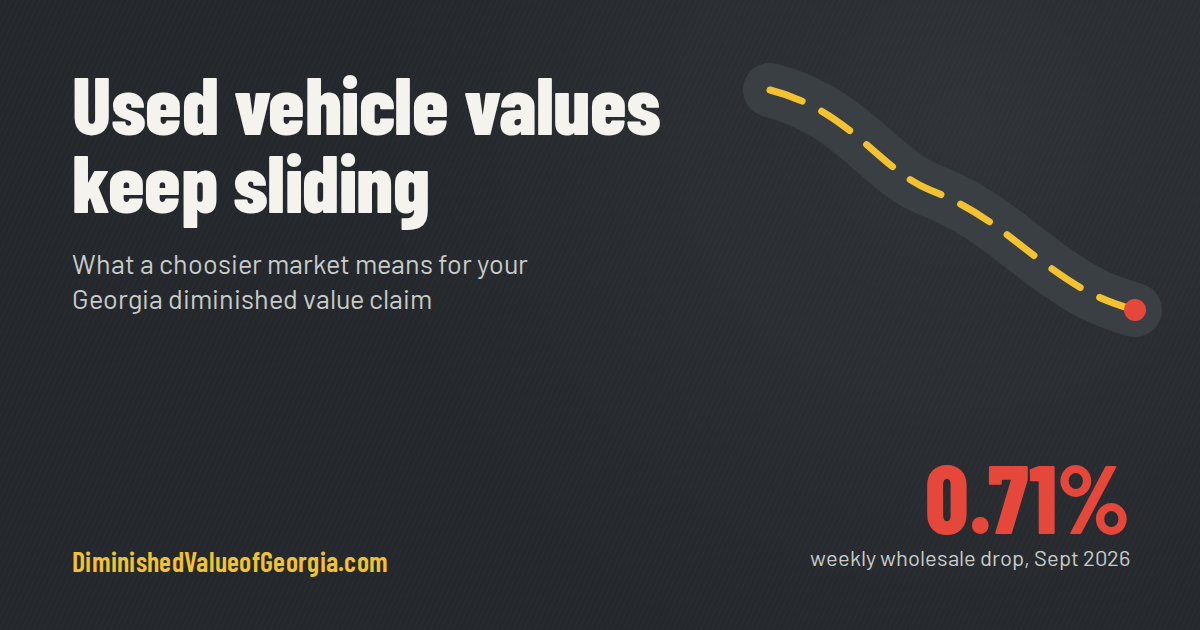
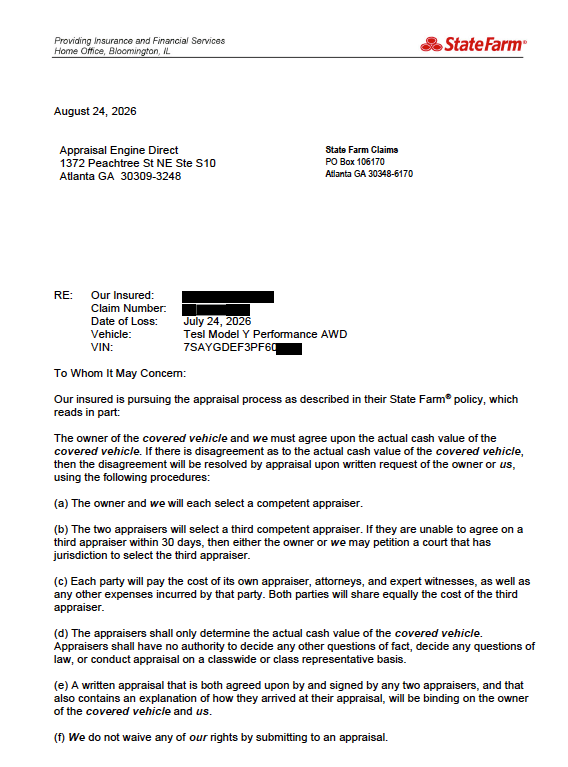
If you were in an accident in Georgia this year, the value of your diminished value claim is being influenced by something most drivers never consider: the used car market.
Diminished value is not calculated in a vacuum. It depends heavily on real-time market conditions. In 2026, used vehicle pricing is shifting again, and that shift is directly impacting how insurance companies evaluate diminished value claims across Georgia.
Understanding what is happening in the market gives you leverage.
The Used Car Market Has Stabilized — But Not Evenly
After years of extreme volatility, used car prices have largely stabilized. However, stabilization does not mean uniform pricing. According to recent used car pricing trends, certain vehicle segments are still correcting faster than others.
Some segments are holding value better than expected. Others are correcting aggressively.
For example:
- Electric vehicles continue to experience accelerated depreciation.
- Luxury sedans remain soft in resale.
- Certain SUVs and trucks still hold stronger demand in the Southeast.
- Higher inventory levels are pushing down prices in select categories.
Insurance companies rely on comparable vehicle sales data to determine pre-accident value. When market conditions fluctuate, comparable selection becomes more sensitive.
In Georgia, where demand for trucks and SUVs remains relatively strong compared to national averages, using national comps instead of local comps can distort a diminished value calculation.
Why Market Trends Matter for Diminished Value
A diminished value claim measures how much resale value your vehicle lost because of the accident.
The formula is simple in theory:
Pre-accident market value
Minus
Post-repair market value
Equals
Diminished value
But the market value itself is dynamic.
If the overall market is declining, insurance carriers may argue that part of the value loss is due to general depreciation, not the accident. If the market is strong, they may attempt to minimize the impact of structural damage. In many cases, insurers also rely on repair estimates to support valuation assumptions.
The problem arises when outdated data is used.
Recent market reports show inventory levels increasing in several vehicle categories, which creates downward pressure in certain segments. If your insurer uses data from months prior, it may not accurately reflect your vehicle’s real pre-loss value.
EV Depreciation Is Changing the Conversation
Electric vehicles are a clear example. Federal tax credits continue to influence EV demand and pricing behavior.
Recent resale trend analyses show EVs depreciating faster than many gas-powered vehicles. If an EV is involved in an accident in Georgia, insurers may attempt to attribute a portion of the value loss to normal market depreciation rather than accident-related stigma.
That distinction matters.
In diminished value claims, separating market depreciation from accident-related loss requires precise valuation modeling.
Georgia Law Still Protects Your Right to Diminished Value
Georgia remains one of the strongest states in the country for diminished value claims due to the precedent established in State Farm v. Mabry.
This means drivers are entitled to pursue diminished value even after repairs are completed.
However, entitlement does not guarantee accuracy. Understanding basic auto insurance total loss rules can also help drivers evaluate how insurers calculate pre-loss value.
Insurance companies often apply internal formulas that cap diminished value based on percentages rather than real resale data. These formula-driven approaches may not fully reflect how the Georgia market responds to accident history.
Local Market Data Is Critical
A vehicle in Atlanta may perform differently than the same vehicle in a rural Georgia county.
Local demand, dealership density, and buyer behavior all influence resale perception.
Using national averages or generic depreciation curves can undervalue a claim.
A proper diminished value analysis in 2026 should consider:
- Local comparable sales
- Current market inventory levels
- Vehicle segment demand in Georgia
- Severity and type of damage
- Structural vs cosmetic impact
- Prior condition and mileage
Modern valuation methods increasingly rely on advanced tools and data to improve accuracy.
The stronger the local data, the stronger the claim.
What Georgia Drivers Should Watch For
If you are filing a diminished value claim in 2026, pay attention to:
- Comparable vehicles used in the insurer’s valuation
- Whether the comps are truly local
- Whether trim levels and options match
- Whether structural damage was properly weighted
- Whether the valuation reflects current market timing
Small adjustments can significantly alter the final payout.
Final Thoughts
Used car market trends in 2026 are quietly shaping diminished value claims in Georgia. Even when repairs are completed properly, accident history affects resale value, and market shifts influence how that loss is calculated.
The difference between a generic formula and a market-based analysis can mean thousands of dollars.
If your diminished value claim feels lower than expected, the issue may not be the accident alone. It may be how the market data was applied.
In Georgia, understanding both the law and the market is the key to a fair outcome.
Download the PDF Version
Prefer to save or share this guide? Download the full Georgia Diminished Value Market Trends 2026 Guide below.