Georgia law is one of the clearest in the country on this question, but insurance companies keep acting like it is not. If your car was damaged in an accident that was not your fault, the at-fault driver’s insurer is required to compensate you for your vehicle’s full property damage, and that includes the drop in market value caused by the accident history. That loss has a name: diminished value. And in Georgia, you have a legal right to pursue it.
What most drivers do not know is exactly how that legal right works, which insurers it applies to, what happens when the claim is denied, and why getting paid fairly almost always requires more than just filing the claim.
The Legal Foundation: What Georgia Law Actually Says
Georgia is a tort state, which means the driver who caused the accident is financially responsible for the full scope of damages. Property damage under Georgia law is not limited to repair costs. It includes any reduction in market value that results from the accident, even after repairs are completed correctly.
The case that established this most clearly is State Farm Mutual Automobile Insurance Co. v. Mabry, decided by the Georgia Supreme Court. That ruling confirmed that insurers cannot categorically refuse to pay diminished value to third-party claimants. The decision removed the main argument insurers had been using to reject these claims outright.
The practical result: if another driver caused your accident and their insurer is handling the property damage claim, that insurer is legally required to consider your diminished value loss as part of the settlement. They cannot simply tell you it is not covered and close the file.
Georgia courts have established that an insurer’s obligation to pay for property damage extends beyond repair costs. Refusing to address diminished value in a third-party claim is not a legitimate denial position under Georgia law.
Third-Party vs. First-Party Claims: The Distinction That Changes Everything
Not every accident scenario produces the same legal footing for a diminished value claim. Whether you are filing against the other driver’s insurance or your own determines what you can realistically pursue.
Third-Party Claims (You Were Not at Fault)
This is the clearest path to a diminished value recovery in Georgia. You file against the at-fault driver’s liability insurance. The insurer is responsible for your property damage in full, which includes diminished value. The Mabry ruling applies here directly.
First-Party Claims (Your Own Insurance)
When you file under your own collision coverage, whether because you were at fault or because you chose to use your own policy, the legal landscape shifts. Georgia courts have not extended the same mandatory diminished value obligation to first-party collision claims. Most standard auto policies in Georgia explicitly exclude first-party diminished value. A small number of specialty policies include it, but they are the exception.
If you were not at fault and are filing against the other driver’s insurer, Georgia law is on your side. If you are filing against your own collision coverage, your recovery options for diminished value are limited to what your specific policy language allows.
How Insurers Try to Minimize What They Pay
Knowing the law gives you standing to file. It does not guarantee a fair payout. Insurance companies have several tools they use to reduce what they actually write the check for.
The 17c Formula
The most common tactic is applying a proprietary calculation developed internally by insurers that systematically produces lower diminished value estimates than the actual market impact reflects. The 17c formula is not a legally mandated standard in Georgia. It is an internal tool that insurers use because, without an independent appraisal on the table, there is nothing to push back against it with.
Arguing the Repair Quality Eliminates the Loss
Adjusters will sometimes claim that because the vehicle was repaired to pre-accident condition, there is no remaining diminished value. This ignores how buyers actually behave in the market. Vehicle history reports flag the accident permanently. Buyers negotiate down based on that flag regardless of repair quality, and the data consistently shows it.
Disputing the Vehicle’s Pre-Loss Value
To calculate diminished value, you need an accurate baseline for what the car was worth before the accident. Insurers sometimes use lower-end valuations as the starting point, which compresses the final diminished value figure. The current Georgia used car market has seen real pricing shifts in 2026 that affect these calculations in ways standard formulas often fail to capture.
Offering a Low Number and Waiting
Many drivers accept the first offer because they do not know it is negotiable or because they assume the insurer’s number is authoritative. It is not. It is a starting position, and accepting it without independent documentation is one of the most common ways legitimate claims get undervalued.
What Georgia Drivers Are Actually Entitled To
Diminished value in Georgia is measured as the difference between what your vehicle was worth immediately before the accident and what it is worth after repairs are complete, on the open market. Three components factor into that calculation:
| Component | What It Measures | Typical Impact |
|---|---|---|
| Inherent Diminished Value | The market stigma of the accident history regardless of repair quality | Highest and most consistent |
| Repair-Related Diminished Value | Value lost due to substandard or incomplete repairs | Varies; requires inspection |
| Immediate Diminished Value | Loss at the moment of the accident before any repairs | Mostly academic; rarely claimed separately |
In practice, most claims focus on inherent diminished value. This is the measurable loss that remains after the vehicle is fully repaired and is the figure an independent appraiser quantifies through market comparables and real sales data.
What Happens When the Insurer Denies or Underpays the Claim
A denial or a suspiciously low offer is not the end of the road. Georgia gives you real options to push back.
Formal Demand Letter
A written demand letter backed by an independent appraisal report puts the insurer on formal notice. It documents your position, states the amount you are claiming, and establishes a paper trail that matters if the dispute escalates. Many claims that were initially denied or minimized settle after a demand letter is sent with supporting documentation.
Georgia’s Appraisal Clause
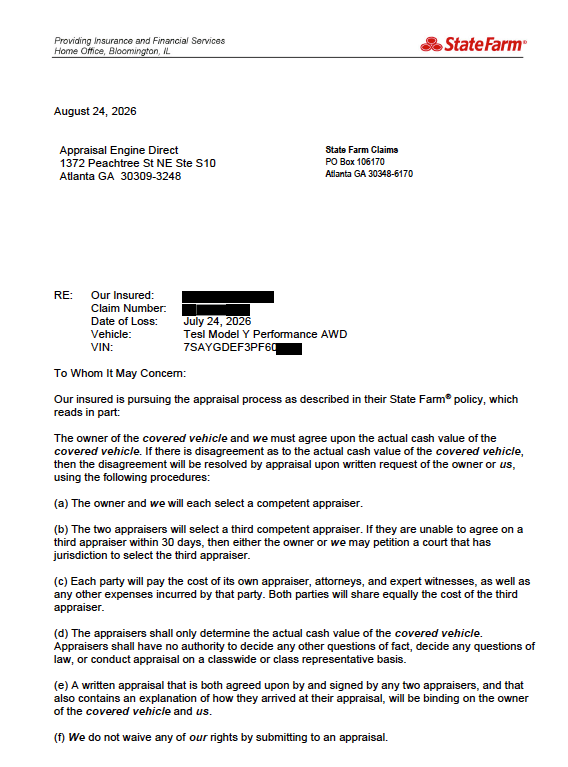
Many auto insurance policies include an appraisal clause that gives you the right to hire an independent appraiser if you disagree with the insurer’s valuation. Each side selects an appraiser, and if they cannot agree, a neutral umpire decides. This mechanism exists specifically to resolve valuation disputes without litigation.
Georgia Magistrate Court
Georgia’s Magistrate Court handles claims up to $15,000 without requiring an attorney. For diminished value disputes that fall within that range, this is a legitimate and relatively accessible option. Filing puts real pressure on the insurer because defending a court case costs them more than paying a fair settlement in most cases.
Georgia Department of Insurance
Filing a complaint with the Georgia Department of Insurance does not guarantee payment, but it creates a regulatory record and sometimes prompts insurers to reconsider their position. It costs nothing and is a useful parallel step when you are in a dispute.
Our detailed guide on what to do when your diminished value claim is denied in Georgia covers each of these paths in full.
Why an Independent Appraisal Is the Most Important Step You Can Take
The insurer’s obligation to pay diminished value under Georgia law is real. But obligation and payment are two different things. The gap between them is almost always closed by documentation, specifically, a certified independent appraisal that assigns a defensible dollar value to your loss based on actual market data.
Without that number, you are negotiating blind. The adjuster has their formula, their comparable sales, and their internal incentive to minimize the check. You have your claim and no independent basis to dispute their figure.
With an appraisal, the dynamic changes. You have a professionally documented loss amount that the insurer has to address, not just acknowledge. The difference between an independent appraisal and the 17c output is often thousands of dollars on the same vehicle. That gap represents real money that belongs to you under Georgia law.
Understanding how Georgia’s diminished value laws apply to your specific situation is the right starting point before you file anything.
Find Out What Your Georgia Diminished Value Claim Is Worth
Get a free estimate from Georgia’s most trusted DV appraisers. Send us your vehicle details and repair documents and we will tell you exactly what you are owed.Get Your Free DV Estimate
Prefer to read this offline? Download the PDF version of this article: Do Insurance Companies Have to Pay Diminished Value in Georgia? (PDF)
Frequently Asked Questions
Are insurance companies legally required to pay diminished value in Georgia?
Yes, for third-party claims. The Georgia Supreme Court’s ruling in State Farm v. Mabry established that insurers cannot categorically deny diminished value claims from drivers who were not at fault. The at-fault driver’s insurer is responsible for the full scope of property damage, which includes any reduction in market value after the accident and repairs.
Does the requirement apply if I file with my own insurance company?
Not automatically. Georgia courts have not extended the same mandatory obligation to first-party collision claims. Standard auto policies in Georgia typically exclude diminished value when you file under your own coverage. If you were not at fault, filing against the other driver’s insurer is the correct path.
What if the insurer pays less than my vehicle actually lost in value?
You can dispute it. Send a formal demand letter backed by an independent appraisal, invoke the appraisal clause in the policy if it applies, or file in Georgia Magistrate Court for amounts up to $15,000. An independent appraisal is the single most effective tool for getting the insurer to take a higher number seriously.
How long do I have to file a diminished value claim in Georgia?
Georgia’s statute of limitations for property damage claims under O.C.G.A. Section 9-3-31 is four years from the date of the accident. That window is longer than most people assume, but waiting weakens your claim. Comparable sales data becomes harder to establish, and repair documentation becomes more difficult to obtain. Filing as soon as repairs are complete produces the strongest case.
Does the at-fault driver’s insurer have to accept my independent appraisal?
They do not have to accept it without question, but they have to respond to it. A professionally documented appraisal from an independent certified appraiser is not something an adjuster can simply ignore the way they can ignore a verbal claim. It establishes a specific, defensible number and shifts the burden onto the insurer to justify paying less.
What vehicles qualify for diminished value claims in Georgia?
Most privately owned vehicles with a clean title prior to the accident and meaningful remaining market value qualify. Newer vehicles, lower mileage, and higher trim levels typically produce larger diminished value amounts because they had more market value to lose. Older vehicles with high mileage and pre-existing issues produce smaller recoveries but can still qualify. A free pre-evaluation will give you a realistic baseline before you commit to a full appraisal.