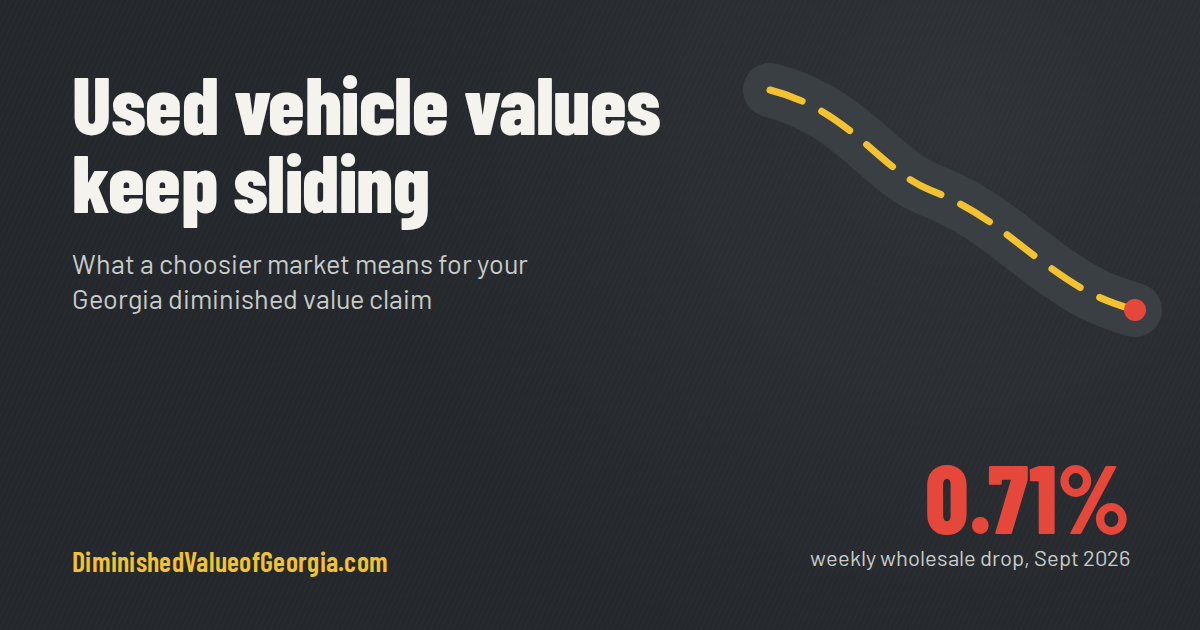
The Black Book 2026 Auto Lending Risk Brief is drawing attention across the auto industry, and for good reason. Repossessions are climbing, loan balances are outpacing vehicle values, and used car prices are under sustained pressure. For vehicle owners in Georgia who have been in an accident, these trends are not background noise. They directly affect how much a diminished value claim is worth and how hard insurance companies will push back on your settlement.
What the Black Book Report Is Showing
Black Book’s lending risk analysis tracks the financial health of auto loans across the country. The 2026 brief points to a clear pattern: more borrowers are falling behind, repossessions are rising, and lenders are tightening approval standards. That combination pushes more vehicles back into the used market, which increases supply and pulls prices down.
For anyone filing a diminished value claim in Georgia, that downward price movement matters. Insurance companies calculate your vehicle’s pre-accident value using current market data. When that data reflects a softer market, your baseline drops before the conversation about accident impact even begins.
In Georgia, you have a legal right to pursue diminished value from the at-fault driver’s insurance. But that right only protects you if the loss is properly documented with current, local market data, not outdated national averages.
How Georgia’s Local Market Conditions Amplify the Problem
National reports give the broad picture. What matters for your claim is what is happening in Georgia specifically. Wholesale auction prices across the state have been softening in 2026 as inventory builds and buyer demand stabilizes. More vehicles moving through Georgia auctions at lower prices means lower comparable sales data, which insurers use directly in their valuation models.
This is the part most policyholders miss. A declining market does not simply reduce your vehicle’s value on paper. It also changes buyer behavior in ways that make accident history more costly at the point of resale. Buyers in a soft market have more options. When they have more options, they avoid vehicles with accident records more aggressively, or demand a steeper discount to take the risk.
The result is a larger gap between a clean-title vehicle and one with an accident history, even if the repairs were done correctly. That gap is what diminished value measures, and it is wider right now than the standard insurance formulas acknowledge.
For more detail on how falling used car prices are reshaping claim outcomes across Georgia, read how 2026 used car price drops are affecting diminished value claims in Georgia.
Why the 17C Formula Fails Even Harder in This Market
Most Georgia insurers still attempt to apply the 17C formula when calculating diminished value. This formula caps the loss at 10 percent of the vehicle’s value before applying a series of multipliers that further reduce the payout. Under normal market conditions, it already underestimates real-world resale losses. In a declining market with heightened buyer sensitivity, the gap between what 17C pays and what you actually lose becomes significantly larger.
The Georgia Insurance Commissioner has acknowledged the limitations of this method. A USPAP-compliant independent appraisal that reflects actual Georgia auction data and current buyer behavior is the only document that accurately captures the real financial loss in this environment.
If you want to understand exactly why 17C falls short, read the full breakdown of the 17C formula and why it is not a fair standard.
Vehicle Type Determines How Much the Lending Risk Trend Affects Your Claim
Not every vehicle loses value at the same rate, and not every segment is equally affected by tightening lending conditions. The table below shows how different vehicle types in Georgia are being impacted in 2026.
| Vehicle Segment | Market Pressure in 2026 | Diminished Value Impact |
|---|---|---|
| Electric Vehicles | High — off-lease supply increasing, demand softening | Elevated — buyers more cautious about battery and tech systems post-accident |
| Luxury Sedans | Moderate to High — weaker demand, more alternatives available | High — buyers heavily discount accident history in this segment |
| Premium SUVs and Trucks | Moderate — auction volume building | Moderate to High — structural damage concerns amplify buyer hesitation |
| Standard Sedans and Compacts | Moderate — stable but competitive | Moderate — accident history still creates a measurable resale penalty |
The segments already experiencing faster depreciation tend to suffer a compounded loss after an accident. The vehicle loses value from market conditions, and then loses additional value because buyers in those segments are more risk-averse about accident history.
How Rising Lending Risk Is Changing Claim Disputes in Georgia
As market conditions shift, the gap between what insurance companies offer and what your vehicle actually lost in resale value is becoming more visible. There are several reasons disputes are becoming more common:
- Lower comparable sales data gives insurers a lower baseline to start from, which reduces the settlement figure before accident impact is even considered.
- Standardized valuation models do not adjust for current buyer hesitation in a declining market. They calculate what was lost on paper, not what buyers are actually discounting in real transactions.
- Policyholders expect payouts based on past market conditions, not on the current softened market, which creates a gap the insurer will use to justify a lower offer.
- Repossession volume adds more competing inventory to the used market, making it harder to sell a vehicle with accident history at a reasonable price.
Understanding how insurers structure their offers in this environment is essential before you respond to or accept any settlement. See how diminished value claims are handled by insurers and what to watch for in settlement offers.
What Georgia Law Gives You and What You Need to Use It
Georgia is one of the strongest states in the country for diminished value rights. You can pursue a third-party claim directly against the at-fault driver’s insurer without filing against your own policy. That protection is real, but it requires documentation to hold up in a negotiation.
An independent appraisal based on current Georgia market data does three things that a standard insurer calculation will not:
- Documents the pre-accident value using actual comparable sales in Georgia, not national averages.
- Quantifies the post-repair resale penalty using real buyer behavior in the current market, not a fixed formula.
- Produces a USPAP-compliant report that can support your position in negotiation, mediation, or court if the insurer refuses a fair settlement.
If you are not sure whether your situation qualifies, start with this guide on qualifying for a diminished value claim in Georgia. And if you want to understand the full legal framework protecting you as a Georgia driver, review Georgia’s diminished value laws.
Get a Free Claim Review Before You Accept Any Offer
If your vehicle was damaged in an accident in Georgia, the current market conditions make it more important than ever to understand your real loss before signing anything. Our team reviews your claim and gives you an honest assessment of what your diminished value may actually be worth.
Request Your Free Claim Review
Download the Free Diminished Value Claim Guide
This guide covers how diminished value claims work in Georgia, which documents matter most, and how current market conditions affect your settlement. A practical reference to have before you speak with any insurance adjuster.
Frequently Asked Questions
What is Black Book’s 2026 Auto Lending Risk Report?
It is a market analysis published by Black Book that tracks lending conditions, borrower delinquency, repossession trends, and used vehicle value movement. The 2026 report shows rising financial pressure across the auto market, which is influencing wholesale prices and insurance claim outcomes, including in Georgia.
How does a softer used car market affect my diminished value claim in Georgia?
When wholesale prices fall, the baseline value of your vehicle before the accident is lower. Insurers use that lower number as the starting point for their calculation. At the same time, buyer selectivity increases in a soft market, which means accident history carries a larger resale penalty. Standard insurance formulas capture the lower baseline but rarely account for increased buyer hesitation, leaving a portion of your real loss uncovered.
Why is the 17C formula a problem in the current market?
The 17C formula uses a fixed 10 percent cap and standard multipliers that do not change with market conditions. In a declining market where buyers are more selective and accident stigma is higher, the formula understates the real resale loss significantly. A USPAP-compliant appraisal based on actual Georgia transaction data is a far more accurate measure of what you lost.
Does vehicle type affect how much diminished value I can claim in Georgia?
Yes. Electric vehicles, luxury sedans, and premium SUVs are facing sharper depreciation and heightened buyer sensitivity in 2026. The same accident on one of these vehicles will typically produce a larger diminished value loss than on a standard compact, because the market treats accident history more harshly in those segments.
When should I get a diminished value appraisal in Georgia?
The best time is after repairs are complete and before you accept or sign any settlement offer. Once you accept an offer, it is very difficult to reopen the claim. An independent appraisal gives you documented evidence of your actual loss before you make that decision.
Can I file a diminished value claim if the accident was not my fault?
Yes. In Georgia, you can file a third-party diminished value claim directly against the at-fault driver’s insurance carrier without going through your own policy. Georgia law is well established on this point, which is one reason having proper documentation matters so much when negotiating a settlement.