State Farm Total Loss Claims Guide
Understanding the contractual dispute process buried in your auto policy.
A note before you read further: this article applies to total loss claims, where the dispute is over your vehicle’s actual cash value. It does not apply to diminished value claims, which involve a separate process for recovering the loss in resale value on a repaired vehicle. We handle both total loss and diminished value claims, so if you are not sure which situation you are in, reach out and we will point you in the right direction.

A letter arrives from State Farm mentioning something called the “appraisal clause,” and suddenly you are staring at legal sounding language with no idea what it means for your claim. Take a breath. This is not a denial, and it is not a red flag. It is a contractual mechanism that has existed in auto policies for decades, and in most cases it works to your advantage.
Below we break down where this clause comes from, why an insurer reaches for it, and what actually happens once it gets triggered.
Where the Appraisal Clause Comes From
Nearly every auto policy on the market includes some version of an appraisal clause. Its job is narrow: settle a dispute over what your vehicle is actually worth when you and the insurer cannot agree.
Most carriers lean on automated valuation platforms, CCC and Mitchell being the two most common, to generate that number in the first place. These systems scrape listings for comparable vehicles and run them through a scoring model. That model is only as good as its inputs, and it frequently misses local market pricing, leans on weak comparables, or knocks value off for condition issues that do not hold up under scrutiny.
Once you have challenged that number and the carrier’s software refuses to move, the appraisal clause becomes the next available lever. It shifts the decision away from the insurer’s internal tool and hands it to an independent process instead.
POLICY LANGUAGE, AS CITED BY STATE FARM
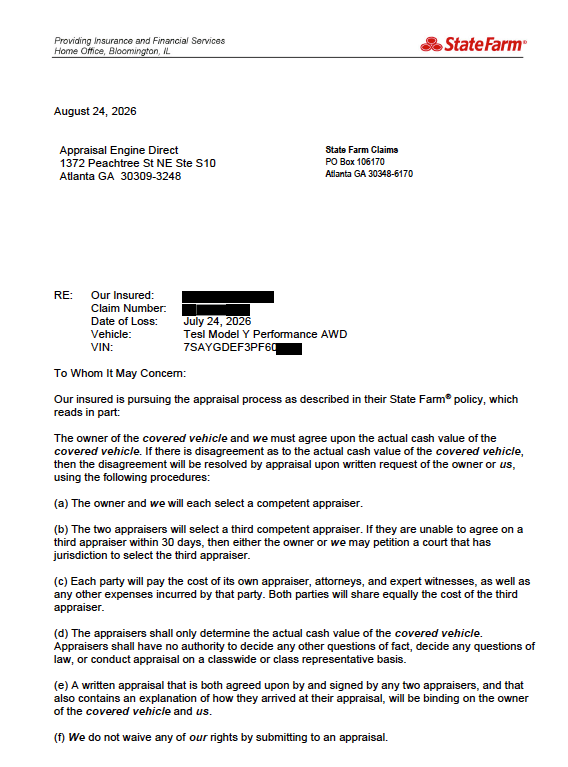
Here is the exact appraisal clause wording a State Farm claim specialist referenced directly in a recent file we handled. This is the language the carrier points to when walking a policyholder through the process.
The owner of the covered vehicle and we must agree upon the actual cash value of the covered vehicle. If there is disagreement as to the actual cash value of the covered vehicle, then the disagreement will be resolved by appraisal upon written request of the owner or us, using the following procedures:
(a) The owner and we will each select a competent appraiser.
(b) The two appraisers will select a third competent appraiser. If they are unable to agree on a third appraiser within 30 days, then either the owner or we may petition a court that has jurisdiction to select the third appraiser.
(c) Each party will pay the cost of its own appraiser, attorneys, and expert witnesses, as well as any other expenses incurred by that party. Both parties will share equally the cost of the third appraiser.
(d) The appraisers shall only determine the actual cash value of the covered vehicle. Appraisers shall have no authority to decide any other questions of fact, decide any questions of law, or conduct appraisal on a classwide or class representative basis.
(e) A written appraisal that is both agreed upon by and signed by any two appraisers, and that also contains an explanation of how they arrived at their appraisal, will be binding on the owner of the covered vehicle and us.
(f) We do not waive any of our rights by submitting to an appraisal.
Source: State Farm Appraisal Clause Letter (PDF), redacted for client privacy.
What Usually Triggers the Letter
In practice, this letter tends to show up after the carrier’s automated system has already run through the comparable vehicles submitted on your behalf and come back with the same number as before. Once that happens, arguing further with the adjuster rarely accomplishes anything, since the adjuster is following what the software tells them.
That is exactly why the clause matters. It opens a door that direct negotiation with the claims department cannot, and it gives you a legitimate shot at a number grounded in real market evidence rather than an algorithm’s output.
What Happens Once the Clause Is Invoked
The exact wording varies slightly by carrier and state, but the mechanics tend to follow the same pattern:
- Both sides bring in their own appraiserYou retain an independent appraiser to represent your interests, and the carrier selects one of its own.
- The two appraisers work the number independentlyThey exchange supporting documentation and comparable sales and try to land on a shared actual cash value.
- Agreement between the two settles itA signed written appraisal from both sides, with an explanation of how they got there, becomes the binding value.
- A stalemate brings in an umpireIf the appraisers cannot agree, they jointly select a third, neutral appraiser. If they cannot agree on who that should be, either party can petition a court to appoint one.
- Two out of three decides itWhichever value two of the three appraisers land on becomes the final, binding number.
Cost wise, each side covers its own appraiser and any related expenses. If the process escalates to an umpire, that cost is generally split down the middle.
Why This Process Tends to Favor You
The real value in invoking this clause is that it takes the algorithm out of the driver’s seat. Rather than a single automated system dictating what you receive, you now have a professional appraiser building your case with actual market data and a methodology that can withstand scrutiny.
If you have already gathered evidence that your vehicle’s value exceeds what was offered, this process is what finally gives that evidence somewhere to go, instead of being brushed aside by a valuation tool that never accounted for it in the first place.
Facing an Appraisal Clause Letter?
If a letter like this landed in your inbox and you are unsure what your next move should be, we can guide you through it and represent your interests throughout the process.
Disclaimer: This article is for informational purposes only and does not constitute legal advice. It reflects our experience handling appraisal disputes on vehicle claims and is not a substitute for advice from a licensed attorney regarding your specific policy or legal rights.