Something changed in how used vehicles are being priced this year, and most drivers filing a claim have no idea it works in their favor. Recent wholesale market reporting shows that vehicle condition is now doing more to set a car’s price than mileage or model year. Older, higher mileage vehicles with strong equipment and clean condition have been outperforming newer, lower mileage units at auction. For a diminished value claim in Georgia, that shift matters, because condition and history are exactly what a collision permanently changes.
Insurers have not updated their thinking. They still lean on formulas built around age, mileage, and a damage severity code. The market moved. The math they use did not.
The Market Shift: Condition Is Outrunning Mileage
Wholesale buyers used to sort inventory by two numbers: model year and odometer reading. That sorting logic is breaking down. Over the past several weeks, industry auction data has shown pricing variation among comparable vehicles inside the same segment, with the same year and similar mileage, trading at meaningfully different money based on equipment, cosmetic condition, and retail appeal.
The reason is simple. Dealers are buying for a retail lot with roughly a 38 day turn time. A unit that needs reconditioning, carries a damage record, or shows repair quality issues sits longer and gets marked down. Buyers are pricing the retail outcome, not the spec sheet.
When condition becomes the primary pricing input, an accident record stops being a footnote on a history report and becomes a direct line item in what a wholesale buyer is willing to pay.
Depreciation Is Also Running Faster Than Normal
The condition shift is happening inside a market that is already softening. Recent weekly wholesale movement has been running at roughly double the pre pandemic seasonal average for this point in the year, with declines showing up across effectively every car and truck segment.
| Weekly Wholesale Movement | Recent Week | Typical Seasonal Pace |
|---|---|---|
| Overall market | -0.57% | -0.25% |
| Car segments | -0.46% | -0.31% |
| Truck and SUV segments | -0.61% | -0.20% |
Two forces are stacking on top of each other for Georgia owners. Your vehicle is losing value to normal market depreciation at an accelerated pace, and it is separately losing value because it now has an accident on record in a market that punishes condition problems harder than it did two years ago. Those are different losses with different remedies, and only one of them is recoverable from an insurer. Our overview of car value depreciation trends covers the baseline side of that equation.
What This Means for a Georgia Diminished Value Claim
Diminished value is the gap between what your repaired vehicle is worth on the open market and what an identical vehicle without an accident record is worth. In a market where buyers are underwriting condition unit by unit, that gap widens. The discount a buyer applies is no longer a rough rule of thumb. It reflects a real reconditioning and resale risk they can quantify.
Repair Quality Is Now a Pricing Input
A repair that restores appearance but leaves panel gaps, paint mismatch, aftermarket structural parts, or an uncalibrated driver assistance system will show up in what the vehicle brings at resale. Wholesale buyers inspect for it. Retail buyers notice it. Georgia insurers, when calculating your payout, rarely account for it at all. The same principle drives how condition is evaluated in a formal appraisal.
The 17c Formula Ignores All of This
The 17c formula caps loss at a fixed percentage of pre accident value, applies a damage multiplier from a severity code, then reduces the result further based on mileage. Nothing in that sequence reflects equipment level, repair quality, regional demand, or how condition sensitive current buyers are. It was built as an internal insurer tool, not as a market valuation method. The problems with the 17c formula are structural, and a condition driven market makes them worse.
If mileage matters less to buyers than it used to, then a formula that discounts your claim primarily on mileage is measuring the wrong thing.
What Georgia Drivers Should Document
In a condition driven market, evidence of condition is what carries a claim. Build the file around it:
- Complete repair order, line by line. Structural work, welding, part replacements, and whether OEM or aftermarket parts were used.
- ADAS calibration records. If your vehicle has forward collision warning, lane keeping, or adaptive cruise, calibration documentation belongs in the file.
- Photos at three stages. Post impact, mid disassembly at the shop, and post repair.
- Service and maintenance history. Proof the vehicle was in strong condition before the loss establishes a higher pre accident baseline.
- Local comparable listings. Same year, trim, mileage, and equipment, pulled from the Georgia market rather than a national average.
- An independent appraisal. The document that converts all of the above into a defensible dollar figure.
Trim and equipment deserve specific attention. When buyers are paying up for configuration, a well equipped vehicle has further to fall once an accident record is attached to it. That is a larger claim, and it only gets recognized if the appraisal documents the configuration properly.
Timing Still Works Against You
Georgia allows four years to file a property damage claim under O.C.G.A. Section 9-3-31, and that window is longer than most drivers assume. It is also not a reason to wait. Comparable sales that support your pre accident value get harder to pull as the market moves. Repair shops purge records. Adjusters treat a claim filed eighteen months after the repair with more skepticism than one filed six weeks after it.
The stronger play is to file while the repair documentation is fresh and the comparable data still reflects the market your vehicle was actually sitting in. Our summary of Georgia diminished value law lays out the legal framework behind the claim.
Find Out What Your Vehicle Actually Lost
Send us your repair documents and vehicle details. We will tell you what your diminished value claim is worth in the current Georgia market, at no cost.Get Your Free DV Estimate
Prefer to read it offline?
Download the full guide as a PDF: Vehicle Condition and Your Georgia Diminished Value Claim (PDF)
Frequently Asked Questions
Does a softening used car market reduce my diminished value claim?
Not directly. Diminished value measures the gap between your repaired vehicle and an identical vehicle with no accident history, at the same point in time. Both values move with the market, so the gap can hold or widen even while overall prices fall. What a softening market does change is urgency, because the comparable sales that support your claim become harder to document as the market shifts.
How does vehicle condition affect what my claim is worth?
Condition is the mechanism through which an accident reduces value. Repair quality, paint match, panel alignment, part origin, and calibration of driver assistance systems all influence what a buyer will pay. With buyers pricing condition more aggressively than they did a few years ago, documented repair deficiencies translate into a larger recoverable loss.
My car has high mileage. Is a diminished value claim still worth filing?
Possibly, and more so than in past years. Wholesale results have shown higher mileage vehicles with strong condition and equipment holding value better than lower mileage vehicles in weaker condition. If your vehicle was well maintained and well equipped, it had real value to lose. A free evaluation will tell you whether the number justifies the process.
Will the insurance company account for repair quality in their offer?
Almost never on their own. Standard insurer calculations run off a damage severity code, the pre accident value, and mileage. Repair quality, part origin, and calibration status are not inputs. If you want those factors reflected in the payout, they have to be documented in an independent appraisal and presented in a demand.
Do I need an independent appraisal to file in Georgia?
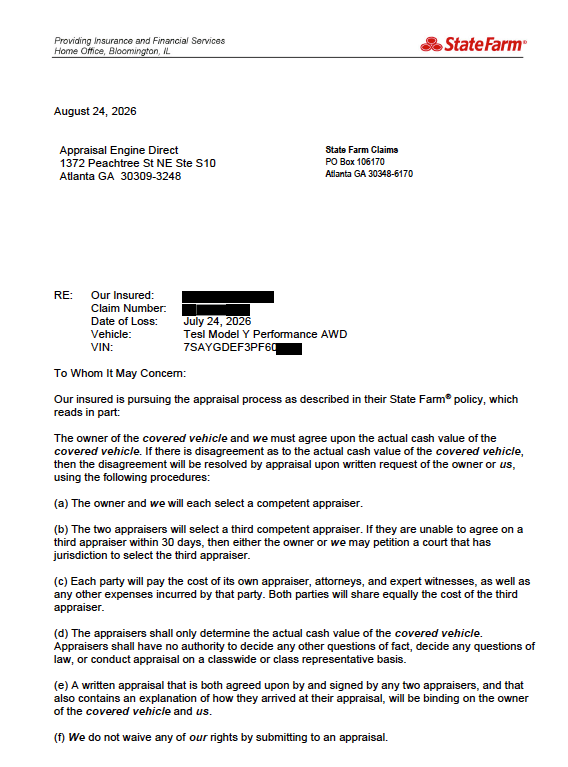
It is not legally required, but filing without one means the insurer sets the number using their own methodology and you have no evidence to dispute it. An independent appraisal built on real comparable sales from the Georgia market is the only practical counterweight.
What if my vehicle was repaired with aftermarket parts?
That is relevant and it should be documented. Aftermarket structural and body parts can affect fit, finish, and buyer perception, and in some cases safety system performance. Note the part origin from the repair order and make sure the appraiser factors it into the valuation.