Where the 17C Formula Came From
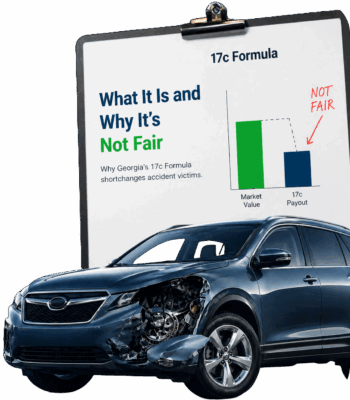
The 17C formula traces back to a 2001 Georgia Supreme Court case, State Farm Mutual Automobile Insurance Company v. Mabry, in which more than 25,000 claimants sought payment for vehicle value lost after repair. The court confirmed that insurers were obligated to pay diminished value claims under their policies.
Because individually evaluating 25,000+ vehicles was impractical, the Superior Court of Muscogee County issued a 2002 order establishing a generic formula with a 10% loss-of-value cap as a manageable compromise for that specific class action.
That’s the origin: a courtroom shortcut for an unusual mass-claims situation—not a scientifically rigorous method designed for individual vehicle valuations. In fact, the Georgia Insurance Commissioner has explicitly directed insurers not to treat 17C as a legal or determinative calculation of diminished value.
How the Formula Works
The 17C formula starts with the vehicle’s pre-accident value (typically from NADA Guides) and runs it through a chain of multipliers:
- Base loss assumption: 10% of pre-accident value
- Damage severity modifier: A factor based on the extent of structural damage
- Mileage modifier: An adjustment based on odometer reading
Because the components are multiplied together rather than added, any inaccuracy in an early factor compounds through the entire calculation—errors amplify, they don’t cancel out.
If you want to see the math for yourself, you can download the 17C Formula worksheet in Excel or view a sample 17C worksheet PDF.
Want to see the formula applied to your own vehicle? Run a free 17c calculator →
Where It Goes Wrong
1. Unreliable Geographic Data
NADA retail values are national benchmarks. They don’t reflect local market conditions—a vehicle in Atlanta may carry significantly different resale stigma than the same vehicle in a rural county. The formula treats every ZIP code identically.
2. An Arbitrary 10% Base Loss
The 10% starting figure comes from no empirical market study. Luxury vehicles, specialty trucks, and sports cars lose value at different rates after accidents than economy sedans. A single flat percentage applied across all vehicle categories produces systematically inaccurate results.
3. Oversimplified Damage Modifier
The damage adjustment is keyed to structural damage, but actual diminished value is driven by buyer perception—not repair cost. A $5,000 airbag and electronics repair often creates more market stigma than $8,000 in frame work. The modifier can’t capture that.
4. Double-Counting Mileage
The NADA pre-accident value already accounts for mileage. Applying a mileage modifier a second time creates a compounding penalty with no market basis. The practical result: vehicles over 100,000 miles frequently calculate out to zero recoverable diminished value under 17C—regardless of what comparable sales data actually shows.
The Many Names of the 17C Formula
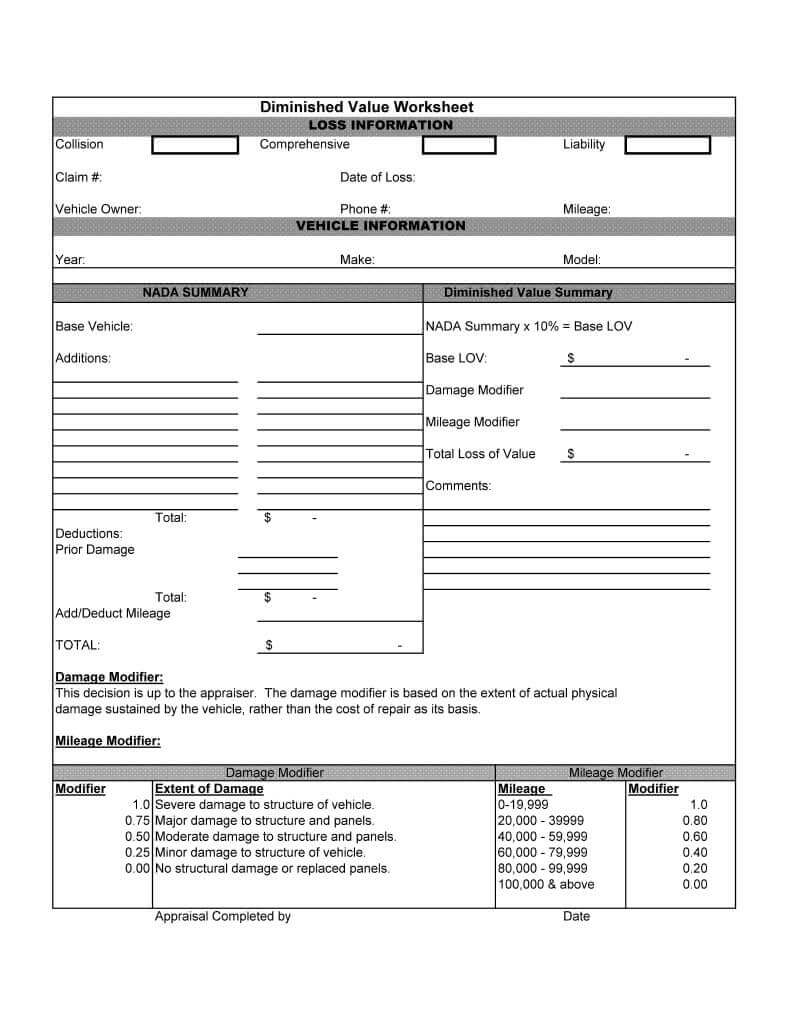
Over the years insurers have adopted the same flawed methodology under different labels. If you see any of these on paperwork from your insurance company, it’s the 17C calculation in disguise:
- Diminished Value 17c Worksheet
- “Evaluation Guideline Worksheet” (USAA Insurance)
- Insurance Company Worksheet for Loss of Value
- Diminished Value Calculator
- Georgia 17C
- Diminished Value Worksheet
- Loss of Value Worksheet
For a deeper breakdown of each component and why it falls short, read the full 17C Formula eBook.
What Georgia Regulators Actually Say
The Georgia Insurance Commissioner has explicitly instructed insurers not to treat the 17C calculation as legally or definitively determinative of diminished value. The directive acknowledges that each vehicle is unique and that actual market loss frequently exceeds what the formula produces.
Despite this, many insurers continue presenting 17C estimates as a standard offer—often without disclosing that the methodology has no regulatory standing as a final determination. This kind of conduct can rise to the level of insurer bad faith, which is illegal under OCGA 33-4-6 and OCGA 33-4-7.
What to Look for in a Third-Party Appraiser
A strong third-party appraisal is the most effective way to overcome a low 17C offer. When evaluating an appraiser, look for:
- A reputation respected by insurance carriers (not flagged for fraud or incompetence)
- An in-person inspection by a licensed appraiser with a valid business license
- Methodology grounded in market data—not a fixed percentage formula
- Experience credible in a court of law if your claim escalates
- Full USPAP compliance in the written report
- No contingency fees and no inflating or deflating values to please the client
For a fuller breakdown, see our guide on why selecting the right appraiser is critical to your claim.
Your Options When a 17C Offer Feels Low
Your Georgia insurance policy entitles you to compensation for your vehicle’s actual diminished value. If the insurer’s figure doesn’t reflect what the market shows, you can:
- Request a detailed breakdown of every modifier the insurer applied
- Commission an independent USPAP-compliant appraisal to document the actual loss
- Use that report to negotiate with real market data behind you
- Escalate to the Georgia Insurance Commissioner or pursue legal remedies under OCGA 33-4-6 and OCGA 33-4-7 if the insurer acts in bad faith
Get an Independent Assessment
At Diminished Value of Georgia, we provide USPAP-compliant appraisals based on in-person inspections and actual comparable market data—not formulas. Our reports document the true loss in value and give you the credibility to negotiate from a position of evidence.
Want to know more about our methodology? Read why clients hire us over formula-based competitors.
Request a Free Diminished Value Estimate
This article is provided as an educational resource on diminished value methodology. Nothing here constitutes legal or financial advice. Written by Tony Rached. Commercial reproduction prohibited without the author’s consent.